
Done On Command Features
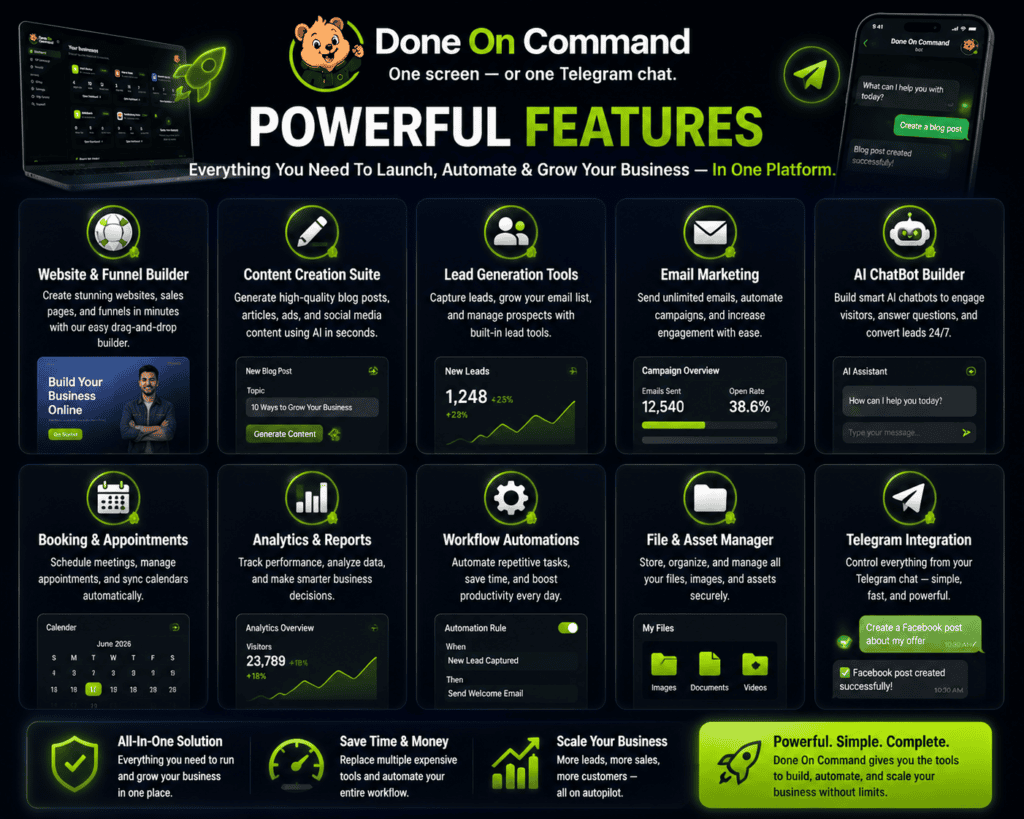
Done On Command combines several marketing and business-production tools inside one AI platform. Its main departments cover pages, video, images, lead generation, email, social media, and website chatbot support.
The important part is not simply the number of tools included. Each department can work from the same persistent business memory.
Once a business profile is created, the platform can reuse its logo, colors, fonts, writing style, products, services, and offers across future tasks. This reduces the need to explain the same brand every time a user creates a new asset.
For a broader product overview, pricing analysis, and purchase guidance, read our complete Done On Command review.
| Feature area | Primary function |
|---|---|
| Persistent memory | Stores and reuses business information |
| Command dashboard | Manages tasks, progress, assets, and approvals |
| Pages | Creates, edits, hosts, and publishes web pages |
| Video | Generates and edits promotional video content |
| Images | Produces branded graphics and creatives |
| Leads | Creates lead magnets and captures prospect information |
| Prepares and sends approved campaigns | |
| Social | Creates and schedules content |
| Front Desk | Provides website chatbot support |
| White-label dashboards | Separates client and business workspaces |
CommandAIHub.com is an independent affiliate information website and is not the official Done On Command website. We may receive a commission if you purchase through one of our links, at no additional cost to you.
Persistent Business Memory
Persistent memory is the foundation of Done On Command.
A user begins by entering a business domain. The platform uses the available information to build a business profile that may contain:
- Logo and visual identity
- Brand colors and fonts
- Writing voice
- Products and services
- Current offers
- General business details
That profile becomes the working memory for future tasks.
For example, a freelancer could create a business profile for a local fitness coach. The platform could then use the same brand colors, coaching offer, and writing style when creating a landing page, promotional video, lead magnet, and email campaign.
Without shared memory, the freelancer would need to repeat those instructions inside several separate tools.
Each business receives its own memory. This is especially important for agencies because client information remains separated rather than being mixed into one general workspace.
Command Dashboard and Telegram Control
The main dashboard acts as the control center for the business.
Users can enter tasks in plain language, monitor progress, review completed work, request changes, and approve outbound actions.
A command could be as simple as:
- “Create a landing page for this offer.”
- “Produce a short promotional video.”
- “Prepare next week’s email campaign.”
- “Build a quiz for lead generation.”
- “Schedule five social posts.”
The platform is browser-based and mobile-friendly. It can also receive commands through Telegram.
Telegram control gives users another way to manage work when they are away from the main dashboard. Supported tasks, revisions, status updates, and approvals can be handled through a conversational interface.
The web dashboard remains the central workspace, while Telegram provides more flexible access.
AI Page Creation
The Pages department can build, edit, host, and publish web pages.
It can be used to create:
- Landing pages
- Offer pages
- Lead-capture pages
- Campaign pages
- Service pages
- Multi-page websites
Users can describe the page they want or upload a screenshot as a design reference.
After the first version is created, revisions can be requested through chat. A user might ask the platform to change a headline, replace an image, add a section, adjust the call to action, or update the offer details.
Revision history is included, making it easier to track changes.
Completed pages can be hosted through the platform and connected to a custom domain.
Page limits
The front-end plan includes:
- Up to 10 page generations per month
- One year of hosting
- A Done On Command watermark on generated pages
Pro doubles the page-generation limit and adds another year of hosting. Agency Platinum removes the DOC watermark from generated pages.
Video Creation and Editing
The Video department handles both new video generation and uploaded footage.
Its functions include:
- Promotional video creation
- AI-generated scenes
- Branded cutaways
- Automatic voiceovers
- Synchronized captions
- Talking-head editing
- Spokesperson-style videos
A user can provide a command and have the platform combine business information, visuals, narration, and captions into a finished video.
Existing footage can also be uploaded for editing. The platform can add captions, visual cutaways, and supporting production elements.
The Spokesperson Studio can create presenter-style content from an uploaded photograph. This may be useful for promotional videos, ads, and UGC-style content.
Generated videos still require human review. Names, prices, pronunciations, claims, captions, and visual details should be checked before publication.
Video limits
The front-end plan includes:
| Video feature | Front-end allowance |
| New videos | Up to 5 per month |
| Video edits | Up to 5 per month |
| Output resolution | Up to 720p |
Pro doubles the video-generation and editing limits while increasing output resolution to as high as 4K.
Branded Image Generation
The Images department creates visual assets using the selected business profile.
Possible uses include:
- Social media graphics
- Ad creatives
- Video thumbnails
- Landing-page visuals
- Promotional images
- Lead-magnet graphics
Because the platform can access the stored business information, generated images can be aligned with the brand’s visual direction and offer.
Users should still inspect colors, logos, text, product representations, and small visual details before using an image publicly.
The front-end plan includes up to 10 image generations per month. Pro doubles that limit.
Lead Magnets and Lead Capture
The Leads department helps users create interactive tools designed to collect prospect information.
Available formats include:
- Quizzes
- Calculators
- Forms
- Interactive tools
- Other lead magnets
A local service provider could create a cost calculator. A coach could build an assessment. An affiliate marketer could produce a quiz connected to a specific audience problem.
Leads can be imported or collected through an agent, CSV file, or form.
The platform can create the lead-generation asset, but it cannot guarantee submissions or conversions. Results still depend on the offer, traffic source, audience, and overall campaign quality.
Email Campaign Management
The Email department can draft, approve, schedule, and send campaigns through a supported autoresponder.
The listed integrations are:
- GetResponse
- GoHighLevel
- Brevo
- Mailchimp
The user’s contact list remains inside the connected email platform.
Done On Command can help prepare:
- Welcome emails
- Promotional campaigns
- Follow-up sequences
- Newsletters
- Re-engagement messages
- Launch campaigns
Every campaign remains approval-gated.
That matters because an email can reach an entire list within seconds. Dates, prices, links, subject lines, claims, and contact information should be checked carefully before approval.
The connected autoresponder may have separate contact limits, sending restrictions, and subscription fees.
Social Content and Scheduling
The Social department can create and schedule content through Upload-Post and Buffer.
Users can prepare posts in advance and organize them through a social calendar.
The same business memory can be applied across multiple posts, helping the brand maintain a more consistent voice and visual identity.
However, users should avoid publishing identical content everywhere without reviewing it.
A professional LinkedIn post may need a different tone from a short-form social caption. Each piece of content should fit the platform, audience, and format where it will appear.
The available networks and publishing limits depend partly on the connected Upload-Post or Buffer account.
Front Desk Chatbot
The Front Desk department provides a chatbot for a business website.
The chatbot answers customer questions using a separate business knowledge base.
It may help visitors find information about:
- Products and services
- Offers
- Business hours
- Policies
- General company details
The chatbot can be installed using an embed code and operates with its own monthly allowance.
Its information should be reviewed regularly. Business hours, prices, products, and policies may change, and outdated chatbot answers can create confusion.
Approval-Gated Publishing
Done On Command keeps outbound work behind an approval gate.
Pages, videos, email campaigns, and social posts should not go live until the user approves them.
The process allows users to:
- Review the completed work.
- Request changes through chat.
- Check the revised version.
- Approve the final action.
This creates a balance between automation and human control.
AI can reduce production time, but users remain responsible for checking accuracy, branding, claims, links, legal wording, and visual quality.
Credits and Personal AI Keys
The front-end plan includes 1,000 credits per month.
Agency Platinum increases the allowance to 5,000 monthly credits. The Mega Bundle raises it to 10,000 credits per month.
Credits are only supposed to be charged when an action is successfully delivered. Failed or declined actions should not consume credits.
Users may also connect a compatible personal AI key.
This is optional because platform credits are already included. A personal key may reduce Done On Command credit usage for eligible AI actions, though the external AI provider may charge separately.
Connecting a personal key does not automatically remove page, image, video, business, or hosting limits.
White-Label Dashboards and Business Capacity
Each business receives a separate white-label dashboard, memory, and asset workspace.
This can help freelancers and agencies manage client work without mixing instructions or branding.
| Plan | Business allowance |
| Front end | Up to 2 |
| Pro | Up to 5 |
| Agency Platinum | Up to 10 |
| Mega Bundle | Unlimited |
Agency Platinum also includes 5,000 monthly credits, agency assets, an agency website, an agency license, and removal of the DOC watermark from generated pages.
Commercial, Agency, and Reseller Rights
The front end includes a commercial license.
This allows users to sell completed services and deliverables, including pages, videos, graphics, lead magnets, campaigns, social content, and chatbot setup.
Agency Platinum adds broader agency capabilities.
Reseller Pro is different. It includes 25 software accounts that the buyer can sell.
| License type | Main use |
| Commercial license | Sell completed work and services |
| Agency license | Manage broader client-service operations |
| Reseller rights | Sell Done On Command accounts |
Done On Command Feature Limits
The front-end plan provides access to every main department, but it includes defined allowances.
| Feature | Front-end limit |
| Businesses | 2 |
| Monthly credits | 1,000 |
| New videos | 5 per month |
| Video edits | 5 per month |
| Video resolution | Up to 720p |
| Images | 10 per month |
| Pages | 10 per month |
| Hosting | 1 year |
| Storage | Up to 1 GB |
| Page watermark | Included |
Users who need more capacity can consider Pro, Agency Platinum, the Everything Bundle, or the Mega Bundle.
Final Feature Summary
Done On Command connects several online business functions through one persistent memory.
Its Pages, Video, Images, Leads, Email, Social, and Front Desk departments can all work from the same business information.
That setup may reduce repeated instructions and help maintain consistency across multiple marketing channels.
The most practical features are:
- Shared business memory
- Separate client dashboards
- Plain-language commands
- Web and Telegram control
- Page hosting and publishing
- Video creation and editing
- Email and social integrations
- Approval before outbound actions
- Commercial use from the front-end plan
The platform still requires human checking, and the front-end generation limits may not fit every user.
For freelancers, affiliate marketers, agencies, and solo business owners who regularly create several types of marketing assets, the connected workflow is the feature that matters most.